
 English
English
English
 German
 Slovenian
 Croatian
If you've ever bitten into a chewy strip of homemade beef jerky, savored a handful of sun-dried tomatoes, or snacked on perfectly crisp apple rings, you already know the magic of dehydrated food. But the moment you decide to invest in a food dehydrator, one question immediately surfaces: Should I go with a commercial unit or a home dehydrator?
It sounds like a simple question, but the answer depends entirely on who you are, what you're drying, and how much you plan to produce. Whether you're a curious home cook, a health-conscious family, a small farmer with surplus harvest, or an entrepreneur building a dried-food business there is a right answer for you. This guide will break it all down clearly so you can invest wisely and start drying smarter.
Before comparing the two types, it helps to understand what a food dehydrator actually does. At its core, a food dehydrator removes moisture from food using a combination of low heat and consistent airflow. By reducing the water content in fruits, vegetables, meats, herbs, and mushrooms, it effectively halts bacterial growth and dramatically extends shelf life all without the need for chemical preservatives or freezing.
The result? Nutrient-dense, lightweight, shelf-stable food that retains its natural flavor and goodness. Whether you're making dried mango slices, crispy kale chips, herb powders, or meat jerky, the principle remains the same. The difference between a commercial and a home food dehydrator lies not in what they do, but in how much, how fast, and how consistently they do it.
A home food dehydrator is a compact, user-friendly appliance built for household or small-batch use. These machines typically feature between 4 to 10 trays, making them ideal for drying a few kilograms of produce at a time. They fit neatly on kitchen countertops, plug into a standard wall socket, and require little to no technical knowledge to operate.
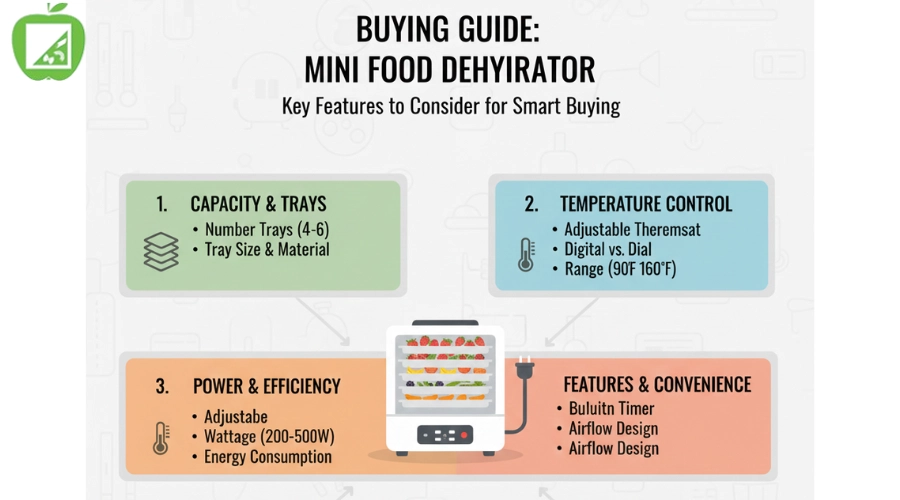
One increasingly popular category within home units is the mini dehydrator a compact, lightweight version designed for smaller households or occasional use. A mini dehydrator is ideal when you want to dry a small batch of herbs from the garden, make a portion of fruit chips for the kids, or experiment with dehydrating without committing to a large appliance. It takes up minimal counter space, uses less electricity, and is often much more affordable than larger home models.
Home dehydrators and mini dehydrator models generally offer:
The trade-off? Home units have limited capacity. If you need to dry 50 kg of produce in a single run, a home food dehydrator simply won't be up to the task.
A commercial food dehydrator is an entirely different beast. Designed for businesses, farms, and high-volume food processors, these machines can handle anywhere from 50 kg to several hundred kilograms of fresh produce per cycle. They are engineered for durability, precision, and continuous operation often running for 24 hours a day without breaking a sweat.
Commercial food dehydrators are built with performance at the forefront:
When it comes to the price of a food dehydrator, the gap between home and commercial models can be significant. A quality mini dehydrator might cost a few hundred euros, while a full commercial system represents a more serious investment. However, the financial lens should always match the use case.
For a family drying seasonal produce to reduce grocery bills and food waste, a home food dehydrator pays for itself quickly. A mini dehydrator, in particular, offers an affordable entry point with very low running costs.
For a business or farm, the calculation looks different. A commercial dehydrator enables you to add significant value to raw produce turning fresh mushrooms, fruits, or vegetables into premium shelf-stable products that command far higher prices in markets, health food stores, or online. The upfront investment is recouped through increased revenue, reduced spoilage and scalable production.
So, Which One Do You Actually Need?
Start with what matches your current reality, not your future ambitions.
If you are drying food occasionally at home, experimenting with healthy snacks, or working with small batches of garden produce, a home food dehydrator or mini dehydrator is the right choice. It's practical, affordable, and more than capable for everyday use.
If you are or plan to become a food producer, farmer, or business owner who needs consistent, high-volume output, a commercial food dehydrator is the investment that will grow with you. The precision controls, capacity, and durability will save time, reduce waste, and support a professional standard of output that a home unit simply cannot match.
The good news? GBS Drytech offers solutions at both ends of the spectrum. Whether you need a compact mini dehydrator for your kitchen drying system for your production facility, our range is designed to match your needs precisely with expert support every step of the way.