
 English
English
English
 German
 Slovenian
 Croatian
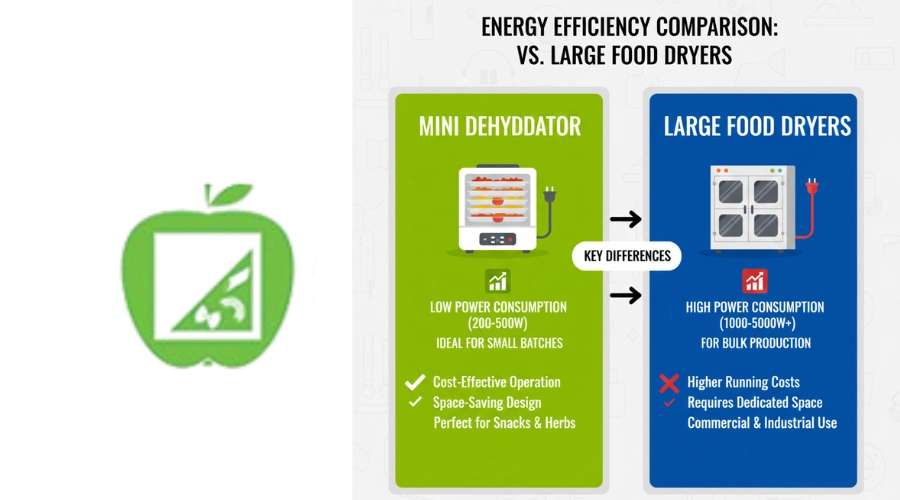
In today's eco-conscious world, energy efficiency is a top priority for kitchen appliances. Food dehydrators, used to preserve fruits, vegetables, meats, and herbs by removing moisture, come in various sizes. Mini dehydrators are compact, portable options perfect for small batches, while large food dryers handle bulk processing for families or commercial use. But which is more energy-efficient? This guide compares mini dehydrators and large food dryers, focusing on power consumption, operational costs, environmental impact, and practical considerations. By the end, you'll know which suits your needs without wasting electricity.
Mini dehydrators, often 4-8 trays with a footprint of 12-18 inches, are designed for home kitchens. They dehydrate smaller quantities, like a few pounds of apples or herbs, making them ideal for individuals or small households. Large food dryers, with 9-20+ trays and a wider base (up to 24 inches), cater to bigger batches, such as dehydrating bushels of produce or making jerky for a crowd. Both use fans and heating elements to circulate air, but their scale affects energy use.
Energy efficiency here means how much electricity the device consumes per unit of food dried, including wattage, drying time, and overall power draw. Factors like insulation, airflow design, and temperature control play key roles.
Power consumption is the most direct measure of energy efficiency. Mini dehydrators typically operate at 200-500 watts, drawing less electricity than a standard light bulb. For example, a popular model like the Nesco Snackmaster Mini uses about 400 watts, running for 8-12 hours to dry a batch of fruit. This equates to roughly 3-5 kWh per session, depending on the load.
Large food dryers, in contrast, often require 600-1000 watts or more. The Excalibur 9-Tray Dehydrator, a large model, consumes around 600 watts, but its extended runtime for bigger batches can lead to 10-20 kWh per use. While minis are efficient for small jobs, larges excel in volume, potentially using more energy overall if not optimized.
However, efficiency isn't just about watts it's about energy per pound of food. Minis might dry 1-2 pounds in 8 hours, using minimal power, while larges handle 5-10 pounds in the same time, spreading energy costs. If you're dehydrating infrequently, a mini could save on electricity; for regular bulk drying, a large one might be more economical per item.
Calculating costs reveals real savings. Assuming an average U.S. electricity rate of $0.12 per kWh, a mini dehydrator's 4 kWh session costs about $0.48. For a large dryer at 15 kWh, that's $1.80. Over a year, if you dehydrate weekly, minis could save $50-100 compared to larges.
But consider usage patterns. Minis are energy-efficient for light users, avoiding the "overkill" of powering a large machine for small tasks. Larges shine in efficiency for high-volume needs, like preserving seasonal harvests, where the per-pound cost drops. Maintenance, such as cleaning or repairs, also factors in minis are simpler and cheaper to upkeep.
Energy efficiency ties directly to environmental sustainability. Mini dehydrators, with lower wattage and shorter runtimes, produce fewer greenhouse gas emissions. A mini might emit 2-3 kg of CO2 per session, versus 8-10 kg for a large dryer, based on average grid emissions.
Larges, however, can be more sustainable for reducing food waste on a larger scale. Dehydrating bulk produce prevents spoilage, potentially lowering the carbon footprint of food production. Opt for models with energy-efficient features like adjustable thermostats or auto-shutoff to minimize impact. Brands like Cosori offer eco-friendly minis with low-power modes, while Excalibur's larges include efficient airflow designs.
Several variables influence how efficiently these dehydrators perform:
Airflow and Design: Vertical airflow in stackable minis ensures even drying, reducing time and energy. Larges with horizontal fans might require more power for uniform results.
Temperature Settings: Precise controls (95-160°F) allow lower temps for delicate foods, saving energy. Digital models in both sizes are more efficient than analog ones.
Insulation and Materials: Well-insulated dehydrators retain heat, cutting down on energy loss. Stainless steel or BPA-free plastic in minis often outperforms cheap plastics in larges.
Batch Size and Load: Running a large dryer half-empty wastes energy; minis are better matched to small loads.
Location and Usage: In cooler climates, dehydrators might need extra power to maintain temps. Using them off-peak hours can leverage lower electricity rates.
Pros: Low energy use (200-500W), portable, quick for small batches, affordable ($30-100). Ideal for beginners or limited space.
Cons: Limited capacity; not efficient for large-scale drying. May require multiple runs for bigger jobs, increasing total energy if not planned well.
Pros: Handles big batches efficiently, potentially lower per-pound energy cost, versatile for commercial or family use.
Cons: Higher upfront power draw (600-1000W+), bulkier, more expensive ($100-300). Overkill for small tasks, leading to wasted energy.
From user reviews on sites like Amazon and Reddit, mini dehydrators like the Presto 06300 shine for energy savings in apartments. One user reported drying herbs with just 2 kWh, costing $0.24. In contrast, large models like the L'EQUIP 528 are praised for dehydrating 10 pounds of jerky in 12 hours at 8 kWh ($0.96), efficient for farmers' markets.
A study by the University of California Extension notes that dehydrators can be 50-70% more energy-efficient than ovens for drying food. Minis edge out for sporadic use, while larges save energy in continuous operation.
Regardless of size, optimize your dehydrator:
The choice between a mini dehydrator and a large food dryer depends on your needs. For small, occasional drying, minis are more energy-efficient, with lower power consumption and costs. Larges offer better efficiency for bulk processing, minimizing waste and long-term expenses. Evaluate your usage, budget, and environmental goals perhaps start with a mini and upgrade if needed. By choosing wisely, you'll enjoy preserved foods while keeping your energy bill and carbon footprint in check. If you're ready to buy, research models with strong reviews for the best bang for your buck.